
Piker's error
A strange blindspot on race blinkers the famous Twitch streamer

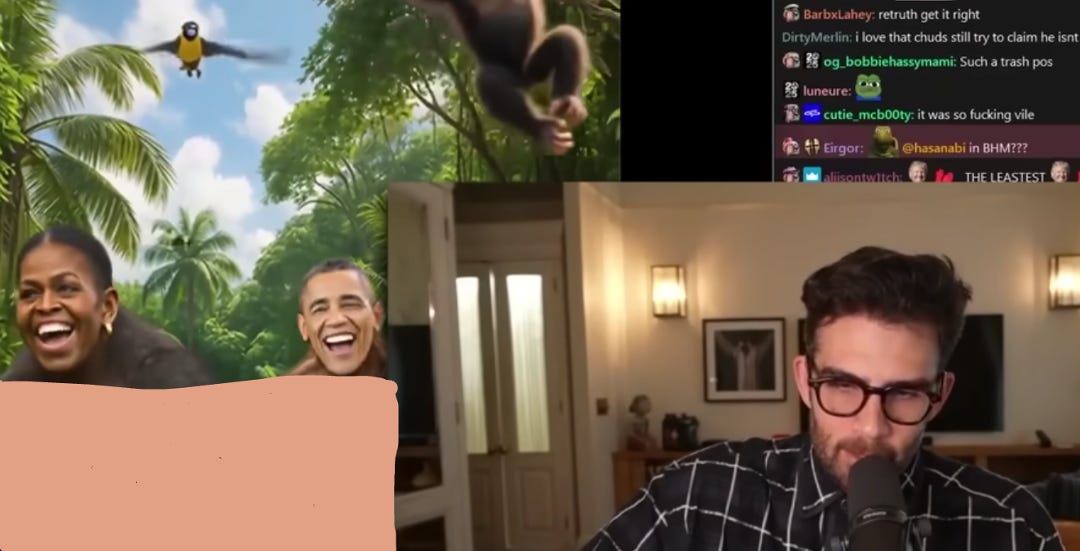
Hasan Piker, in a recent Twitch stream, remarked on Donald Trump’s late-night release of incendiary racist material featuring former president Barack Obama and former first lady Michelle Obama. While he denounced Trump’s posting of the meme in no uncertain words, Piker took it upon himself to declare that the image now should be shown because “we’re all adults” and it’s just “a stupid meme.”
In case you hadn’t heard about the brouhaha, last weekend Trump shared a conspiracy video that implied that the 2020 U.S. election (one of Trump’s most enduring obsessions) had been hacked via Chinese computer chips. That was wild enough, but spliced at the end of that video was an AI creation, set thematically to the Lion King, replete with “The Lion Sleeps Tonight” as a musical backdrop. This video featured various Democratic leaders and lawmakers as jungle residents.
Most vividly, the heads of the Obamas were set atop bodies of what look to be gorillas.
Piker, to his credit, has for many years spoken about the perniciousness of anti-Black racism, explaining to his audience the particular peculiarities of this long-standing American bigotry. He’s said himself that, as someone who identifies as White, he can’t truly imagine what it’s like to be Black in the United States. This is why I feel quite comfortable calling him out: he’s aware, yet he’s falling prey to some blind spot.
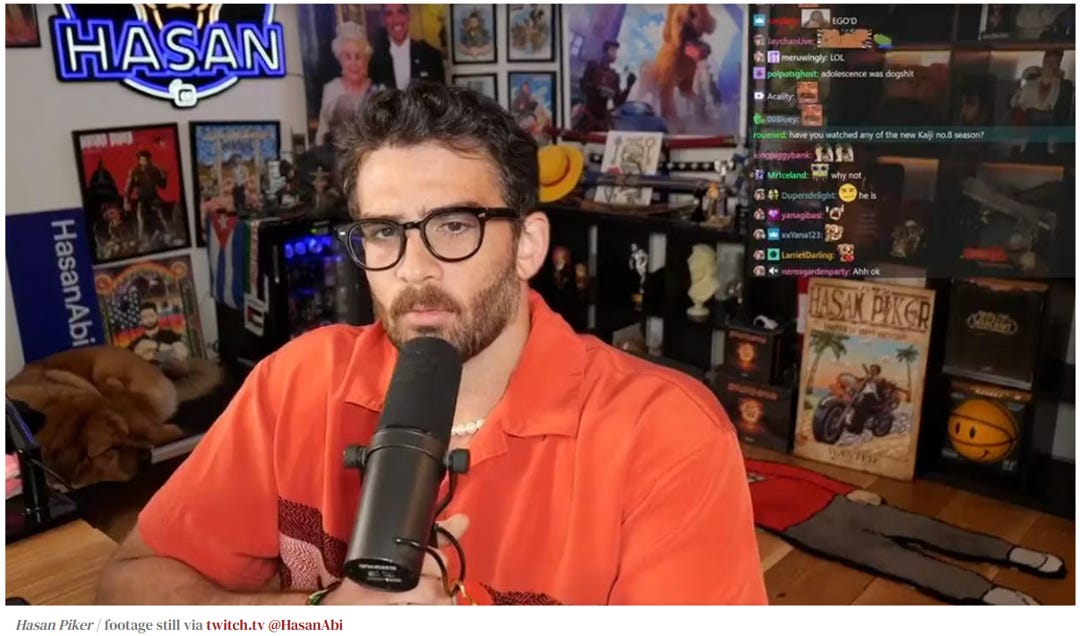
Regarding the video, Piker notes precisely why it garnered as much interest — and condemnation — as it did:
“A depiction of famous Black people as apes or monkeys is very unfiltered — the type of racism that everybody understands exactly what’s going on, right? There’s not really a lot of plausible deniability there. It’s basically the equivalent of saying the N-word.”1
Yet, despite that level of understanding, Piker defended his decision to let the clip roll at length — and, by extension, the furthering of this video’s spread.
“Can I say something controversial? Maybe my Black HasanAbi fans will get mad at me for saying this. I don’t think they [the media] should shy away from showing it. Like, we’re all adults, man. [Trump] posted that shit. I think it’s a disservice not to show exactly what he was posting.
“Is that controversial? Like, am I being white on this? Like, is this, you know, Caucasian activities?”2
He knew he was flirting with being offensive. To stave that off, Piker attempted to neutralize that by confronting the issue head-on.
“I don’t want to speak out of turn here for, you know, my Black chatters, but we’ve all seen shit like this, right? I don’t know. I can only compare it to Islamophobic shit that I receive with regular frequency. And, yeah, it’s not pleasant to see stuff like that — you know, my face superimposed over Osama bin Laden or something, or saying that I’m an ISIS fighter or whatever.
“It’s not great to see it, but I would much rather have everybody see the shame that these people are bringing about themselves than not. It almost feels like you’re helping this person, right?
“It’s very cringe, and I understand why it invokes certain feelings. I’m much more in line with not showing certain images like, you know, George Floyd, right? I don’t, because a lot of people will go back and forth on things like that. Real violence that a real human being has received is very different than this kind of nonsensical shit.”3
Continuing the thought, he said:
“We don’t need to see state violence like that. I understand people wringing their hands over that. Someone died in that instant. But this is a stupid meme. [...] The calculation is different on this one because this is — the slight here is imagery, right? And if you don’t show the offending image, then you’re doing a disservice.”4
Piker, one of the foremost online creators who deals with visual content, is absolutely wrong. Anti-racists should decline to show the meme Trump shared. The reason for this is obvious but, for some reason, Piker misunderstands the dynamite he’s handling.
The situation’s doubly ironic, because he correctly notes that one of the main roles of Black people in the Republican party is to sanitize the racism of that party by having Black faces deny that conservative messaging is racist. “Let’s be real,” he said. “There’s only one role that Black Republicans play in the party, okay? And that is the role of a token who sits there and says, ‘As a Black American, I’ve experienced (insert Republican position here).’”5
He understands the perniciousness of that type of Trojan horsing. Yet, by propagating the putrid racist image Trump released into the world, Piker fails to see that he’s the hollow one with contents spewing out.
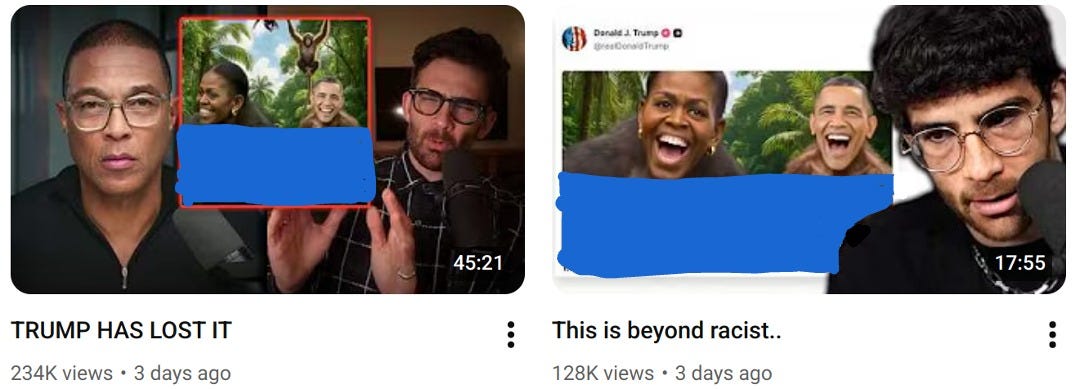
(I’m not one for censorship for censorship’s sake, but I’ve screened these images blue to concretize my objections — otherwise, I’d be as guilty as Piker in disseminating the meme. The original thumbnails are available at HasanAbi on YouTube, if you would like to seek them out yourself.)
In times like this, the words of Merrill Kaplan return to me. Kaplan, a folklorist, said in a now-private YouTube video, “Nothing travels as fast as a joke, and sometimes the joke is carrying signal that is a dangerous narrative material.”6
It’d be one thing if the offense were just something Trump said (i.e., an aural soundbite). Such a snippet could be transformed into text and made somewhat less immediate, in terms of its assault on the senses. However, audio of such a soundbite affects people instantly, because utterances are deciphered by the brain for meaning in an obligatory fashion: one cannot opt out of translating a verbal soundwave once it’s detected. Vision is even more immediate.
So in a different form, such as text, there would be ways to mitigate he message. But a visual meme is — pardon the pun — its own animal.
One of the most effective forms of propaganda is an image paired with a single word or simple phrase. Why? The reason has to do with how the brain arranges meaning and stores information.
The crux of a straightforward meme (image + word) works by associative learning.
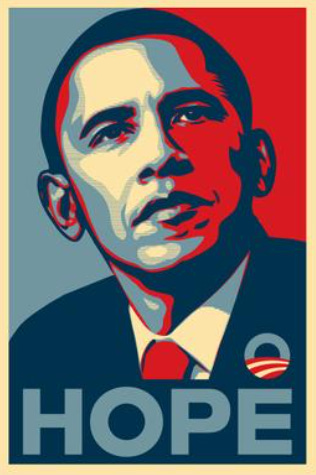
The Obama Hope poster from his 2008 campaign is structured like a classic meme.
Simple pairings are easily incorporated as a single bit of information. As they are stored in tandem, they are recalled in tandem. Basic stereotypes work precisely this way.
So you have this powerful meme, made all the more pungent by its drawing upon centuries of work by its parent trope. That’s to say, this racist idea of Black people as animals (but especially simians) is one of the oldest anti-Black stereotypes in Western culture. So there’s a natural amplification at work here, a cultural amphitheater of animus.
We also know that, with just about any type of learning but especially associative learning, the greater exposure to a concept reinforces that concept in memory. It engrains it. The more a person encounters an item in his or her environment, the truer that item becomes to that person and the more they expect to see it in their environment. (If I were foraging for berries week after week in a certain wooded spot and came across blueberries in one particular patch of shrubs, I’d come to associate blueberries with that patch, and whenever in the area I’d expect to see them.)
So we see that memes, when executed well, succeed because they lodge themselves in memory.
That’s one-half of the story. The other is the fact that those who share the meme contribute to its original messaging, whether the sharers understand that or not. The fissile material is still radioactive.
And this is the terrible genius behind these racist spectacles by Trump and others: when the incident is covered, if the presenter shows the offending material, that material affects an audience that otherwise may not have ever come in contact with such content. In this way, the presenter becomes a carrier of racism.
Piker’s nonchalance is bothersome. He equates showing that imagery with anti-Islam hatred that he receives on an individual basis. This is a poor comparison, on two counts. First, while religion is a protected attribute under anti-discrimination law, it is a trait that is voluntarily adopted and that can voluntarily be renounced if one so wishes. What we socially call race cannot be discarded in this way. Race and religion are not comparable in this context.
Second, the hate mail that Hasan Piker receives, while deplorable in itself, is limited to his eyes only (and to that of the person or persons screening his mail). That hate is not propagated: it is not intended for a mass audience, and even if Piker were to share it with his fan base, the message was not structured to serve as propaganda.
That “Lion King” meme, on the other hand, was meant to sear itself into the memory banks of everyone who encountered it — in fact, it had a leg up on that task, as it paired itself with “The Lion Sleeps Tonight,” a song that’s been in American consciousness for decades.
That flashbulb memory of bright cartoon color and upbeat South African tune lodges the meme in the mind, and the association is complete. The trope of Blacks-as-jungle-beasts finds new fire in three unblemished generations, corrupted at one blow by exposure to this symbol. Repeated exposure only deepens the association.
Compared to the hate mail sent Hasan’s way, this meme is operationally different and so must be handled differently.
The overarching problem with the meme that Trump disseminated and deleted — but for which he then refused to apologize — is that the human mind takes metaphor at face value.7
“One of the psychological processes that enabled anti-Semites such as the Nazis to murder Jews — as well as Gypsies, homosexuals, Slavs, and other ‘inferior’ people — without feeling remorse, shame, guilt, or horror at their own actions, was that of dehumanization and demonization. The killers had convinced themselves that the people they were killing were not human, that they were demons, monsters, or plague-bearing rats, and that they had to be exterminated so as to save the German nation....” — Avner Falk
In the mind’s eye, what is imagined is what is true. René Magritte’s great piece “The Treachery of Images”8 illustrates this.
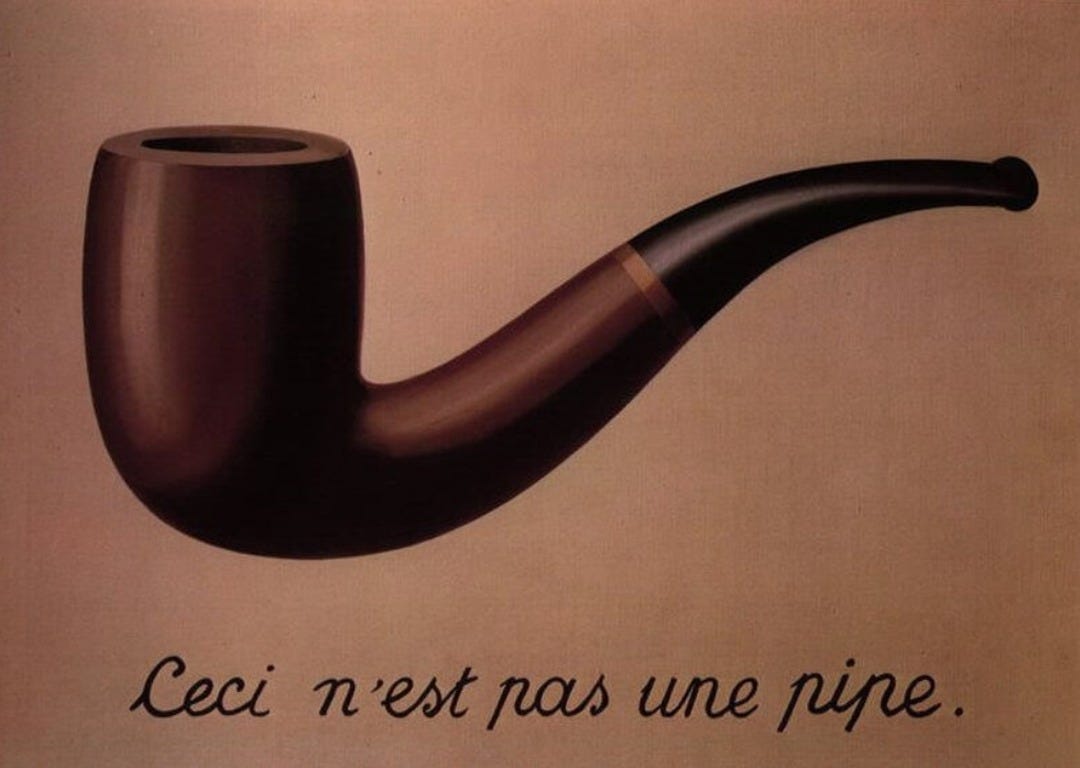
The depiction of a pipe is not a pipe, it is an abstraction; but when a person views a drawing of a pipe, that drawing is a pipe. Similarly, when we sit with small children and show them pictures in a picture book, we don’t say, “Here is a photo of the object we call a ball”; we point to the image and say, “This is a ball.” Human minds equate these effortlessly and automatically.9
“Human speech is metaphorical in its very essence; it is filled with similes and analogies. The primitive mind is unable to understand these similes in a merely metaphorical sense. It takes them for realities and it thinks and acts according to this principle.” — Ernst Cassirer
This is the underlying danger of racist images, and why visual propaganda should be handled with care.
It’s important to keep in mind that the fascist project underway in America is a speedrunning of racism, aimed at three generations that did not grow up immersed in racist vernacular, structures and thought forms. What Trump and Stephen Miller (and, to a lesser extent, J. D. Vance and Steve Bannon) are doing is a form of tutelage, top-down instruction on the fundamental bases of a race-based worldview.
In that sense, Trump reaching for Blacks-as-simians imagery is a return to first principles. He’s feeding these baby racists their first fruit, that of one of the oldest slurs in the cultural storehouse. To that end, Hasan Piker — a self-described anti-racist — should not enable Trump in this endeavor.
“Trump’s AI Meme Crossed the Line,” Hasanverse, YouTube, February 6, 2026, ~9:30.
“Trump Won’t Apologize,” HasanAbi Archive, YouTube, February 7, 2026, ~2:21.
Ibid., ~3:22.
Ibid., ~5:12, ~5:32.
Ibid., ~9:33.
Merrill illustrated her point by speaking of the long-running joke of people receiving “Soros bucks” or checks from the well-known philanthropist: “[W]hen those periodic rumors come up about how Antifa is going to start the Revolution, those happen hand-in-hand with ‘Antifa-types’ — just bear with the shorthand there — joking on Twitter about how there’s going to be an uprising, and then [there’s] an actual response from militia types who are seeing that. It’s the cycle between joke and rumor. And that results in militia-types actually showing up and mustering someplace with large guns.” (“Merrill Kaplan | The Far-Right: Examining its Roots and Challenging its Reach,” Mershon Center, YouTube, November 14, 2022, ~24:48)
The Falk quote can be found in his essay “Collective Psychological Processes in Anti-Semitism,” Jewish Political Studies Review (Spring 2006), Vol. 18, No. 1/2, pp. 40-41.
This iconic painting dates back to 1929.
The Cassirer quote can be found in his book The Myth of the State (1946), p. 21.
With regard to legacy media, I think that there is a rule (either explicit or unspoken) that that kind of vulgar ethnic humor can’t be depicted. Maybe it stems from I Love Lucy, which basically set the tone for TV, as Desi Arnaz said that there was to be no ethnic humor. Regardless, it’s just not shown. I remember during the Charlie Hebdo shooting aftermath that American legacy media refused to show some of the cartoons that used extremely racist imagery.
I personally don’t mind the cartoon not being shown because most Americans, regardless of race, are extremely ignorant on the history of racist imagery and the “debate” would hinge on a very tedious right-wing focused discussion on “free speech.” Because the right frames everything as a “joke” (why are you so mad bro, can’t you take a joke lol), it’s basically impossible to push back against these kinds of things in any meaningful way.
I completely agree with you. Strong outrage is the only decent response, and the image should not be re-posted. I remember seeing a horrific cartoon drawing of Michelle Obama, which I won't even describe. It left me shocked by the depth of racism that inspired the artist and the poster. They should be called out, but the image should not be disseminated. I actually can't imagine the feelings of POC in our society who are confronted with such vileness.