
Fascism o’clock
Heather Cox Richardson, belatedly, joins the rest of us in identifying the Trump administration for what it is

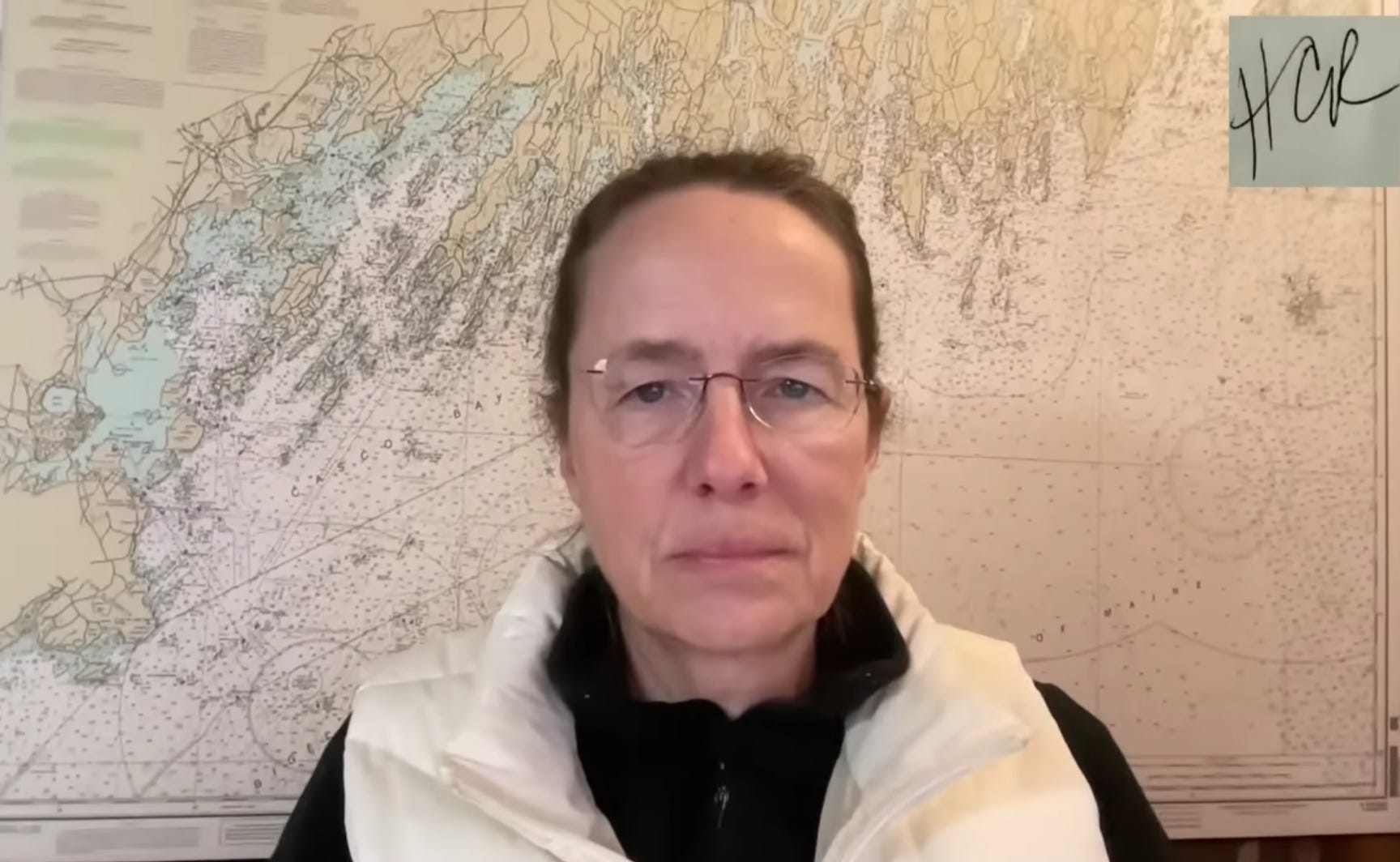
Something happened this week that I’ve been requesting for almost a year. It’s only right that I acknowledge it, despite it being so laggard as to be possibly too late.
Heather Cox Richardson, historian (and fellow American studies scholar), streams her views on current events semiweekly on various media, as is her custom. Tuesday, fresh off of the stunning developments by the U.S. military, she focused on how much the operation in Venezuela and abduction of leader Nicolás Maduro signaled a historic turning point, not only in terms of American policy but in Donald Trump’s administration going forward. The unilateral action, coupled with Trump’s diminishing cognitive state, augured a future unpredictable and dark.
But what a difference a day makes. Wednesday happened, with all of its attendant events (described more fully below), and then Thursday HCR returned to her stream and launched right into a segment on fascism. “It’s time,” she said.
Now I, the intrepid viewer at home, did not view her commentary live, so by the time I came upon the video on YouTube it had already been sectioned. Looking at the chapter headings, I could see that she was indeed about to talk about fascism. And while it only jogged me for a second (“Oh, really? Interesting”), my main reaction was impatience.
“She’s going to talk about fascism now? She’s only about a year behind.”
Perhaps I could’ve been more welcoming in my reception. Yet I could not help but recall several interviews she’d had throughout 2025 where she pointedly declined to describe the Trump administration in such terms. Jim Acosta had her as a guest and asked rather directly — surely she agreed that what we were seeing was fascism. She demurred. Authoritarianism was the farthest she was willing to go.
Despite the hint of pleading in Acosta’s question, she disagreed with his assessment from a position of authority as an academic and scholar. She failed to communicate a sense of urgency to Acosta’s audience and, indeed, any of the audiences she addressed all of last year, because she wanted to hang onto a stale, rather antiquated definition of fascism as being tied to a particular economic system. It was infuriating.
All of that wasted time, when we in the grassroots could have been at a heightened state of alert. She could have been the clarion call to signal us to start networking and organizing in preparation for what was ahead. Now, as I anticipated what she was about to say, I could only regret the year of lost ground.
She began her stream with a halting and, dare I say, rudimentary description of what fascism is, first distinguishing it from its use as an insult (as it’s often deployed in the US), then resorting to language that felt more appropriate to storytime than a presentation for a presumably erudite audience.
“I’m going to start somewhere that you don’t expect me to start, but it’s time. I want to talk to you about fascism and what fascism is, because I think we have this reluctance in this country, really, to grapple with the concepts of really big ideas like [this]....
“Fascism is a form of government that relies on the idea that the vast majority of people should not and cannot have input into their form of government, because they’re just not as smart or as able as a very small group of people — about 10% — is the way the initial ideas of fascism talked about who should rule a society….
“So, first of all, the idea that only a few people really know what’s going on and should rule inherently means that some people are better than others. That means that some people are better than others.
“So that, of course, means that there’s one person who should be at the top of that, because if there are gradations to people[,] there’s got to be somebody who’s really good. But it also means that the mass of people have to be directed by that small group of people. They have to be brought in behind that small group of people.
“And the way you do that, according to fascist thinkers, is by creating an Other by splitting a population along lines of religion or race. You set this idea that there is somehow a small group of people who are the good guys and everybody else is a bad guy. They use different words than that, but that’s the scheme of it.... So you’re deliberately saying, ‘We’re the good guys and they’re the bad guys,’ and often they define those bad guys as socialists... or as ‘the radical left’....
“What that really does is it solidifies [the] ingroup, because you don’t want to be one of the outgroup.... So you deliberately split a population, and then once you’ve got that ingroup, you know, sort of eating out of your hand, you convince them that they are the true members of that society, that they are the ones who can usher in a resurgence of a great past, that they don’t need other countries, that you need to kill all kinds of foreign ties because those foreigners are no good.” (~ 2:03)
What had changed from Tuesday to Thursday? An everyday citizen was shot to death at point-blank range by an agent of the state. That act seemed to be taken on a whim, unjustified by the situation and indeed counter to law enforcement standards.
This was bad enough, but what set off alarm bells for HRC was the fact that the Trump administration, instead of being circumspect and pledging a full investigation, immediately spun a tale demonizing the murder victim and communicating details that were at direct odds with the video evidence that was already available to the public.
Noem characterized Good as a domestic terrorist within hours of Good’s death.
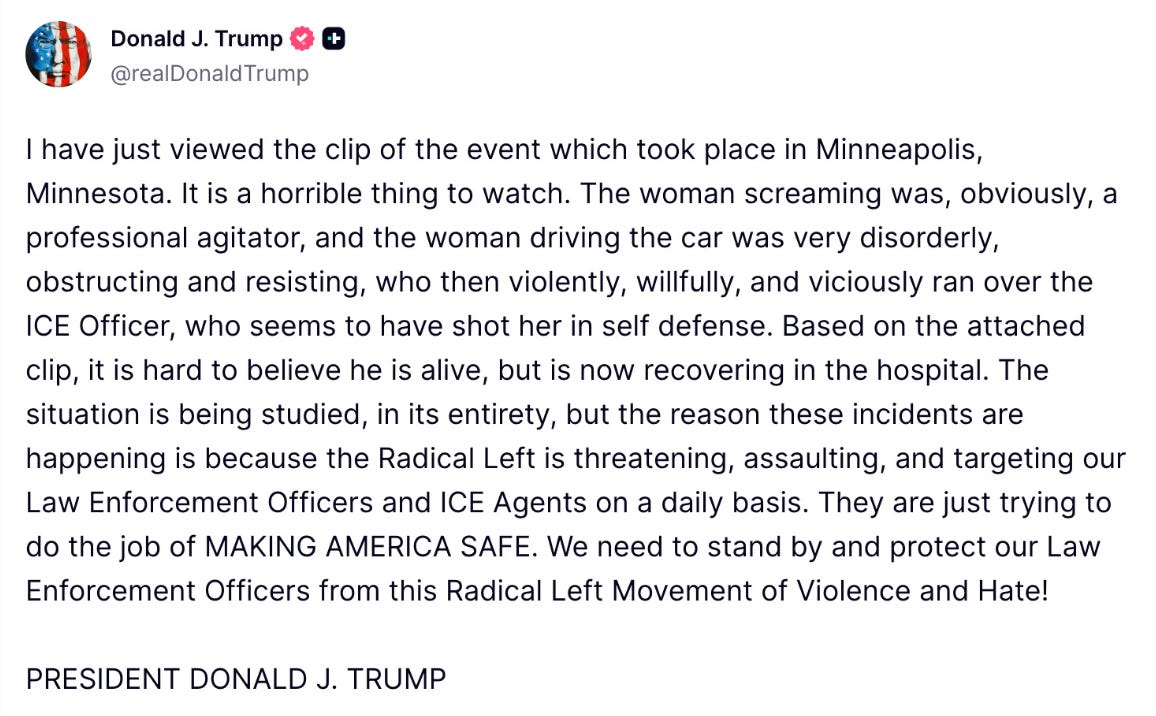
These moves by Kristi Noem, Homeland Security director, and Trump himself through a Truth Social post that same day, checked off a specific box in HRC’s mind: that of George Orwell’s Big Brother from 1984, which demanded that one deny one’s own senses and instead swallow the official line.
The Party told you to reject the evidence of your eyes and ears. It was their final, most essential command.
— George Orwell, 1984
Gone was her reservation that a specific economic style need be present for fascism to exist. (Perhaps it went without saying that the subsequent developments of the action in South America led to a new interpretation: Trump himself declared that he personally would take command of all proceeds from the sale of Venezuelan oil, the largest oil reserves in the world. Maybe that weighted the evidence.)
Still, it wasn’t as though the Trump administration had somersaulted overnight. This gang of players didn’t turn a new cheek. The issues that were on display this week have been there from the start. Trump et al. have lied to the American public. They’ve hidden evidence. They’ve arrogated powers not theirs to themselves. ICE, the agency involved in this deliberate killing, has caused mayhem all year, particularly for the Hispanic and Latino communities, using the thin pretext of crimefighting to detain, arrest, abuse and deport hundreds of thousands. The agency, in these sweeps, had jailed US citizens with stunning negligence and, before Renee Nicole Good’s murder Wednesday morning in Minneapolis, killed at least five people in these raids.
All of this already had been going on. But, for HRC, something had changed.
I want to grant her every bit of grace possible, as she speaks extemporaneously when she livestreams. That’s not easy to do. Yet I must say that HRC’s reason for heralding Good’s murder as a turning point was... disheartening. For those who tune into her streams or read her daily newsletter, she is an authority who helps demystify not just that day’s news but also the broader historical moment. Her answer felt underwhelming — yet also, in its lack of polish, revealing.
With a hint of apology, she noted that, for many Americans, the heinous slaying of Good made plain that the same fate could be in store for them. Good’s death brought it home — it made the fascism real, thanks to the fact that Good “looked like them.” She was a White suburban mother driving a Honda Pilot. Suddenly, ICE’s actions no longer were a faceless process but an outcome that could happen any day, on any street, within the inner circle.
“The violence [in the US] has overwhelmingly been against brown Americans and against black Americans. White Americans have certainly experienced violence, but they have not had that lightbulb moment. The shooting of Ms. Good is a gamechanger in that, for the first time, white Americans can see on their phones the power of the State being used to kill somebody just like them.... For a lot of people who maybe [weren’t paying] a lot of attention, they are now looking at that [footage] and saying, ‘That could be me.’” (~ 11:41)
There’s a lot that could be said about this phenomenon (that is, when it is that Americans recognize themselves in victims). That’s a conversation for another time. Suffice it to say that many are willing to evoke the memory of Kent State to contextualize the significance of Good’s death (with some stretching back even to the Boston Massacre, the flame that ignited the Revolutionary War).
Even with all of this said, near the end of the stream, HRC, true to form, reverted to cheerleader mode. Despite having rung the bell, despite having highlighted the depths of our situation, she fell back to seeking bright sides and silver linings. I’m not sure why she sees this as her role. At some point, she’ll need to confront whether or not she is actually giving viewers false hope (or, viewed in another light, false solace).
If she means to communicate that we’re yet in the fight, that terrible forces haven’t yet overcome us, I’d argue that’s obvious, as we can still hear her. When things get bad, we will no longer have access to what she has to say. She should take time to tutor her viewership with the time still granted to her. Danger’s ahead, and many are woefully unprepared to even anticipate, let alone navigate, what’s coming.
She never even spoke out against the genocide in Gaza, which is ongoing, but getting less media attention than ever. If magats are reading her Letters, who knows, then her moderate approach might get through to them better. Lastly, I hope that there are lots of people out there who have empathy for victims, whether they have the same color of skin or not. What an utter catastrophe.
I follow HCR and share your view. She, like a lot of our folks, he get appearances on the tv shows, downplayed the threat. Maybe they were hopeful plus did not want the public to become alarmed. We needed to be alarmed tho.
I remember way back when I asked you for examples of fascism being defeated by peaceful means. And your answer was factual. Once the fascists get into the power spots, they don’t follow laws, rules, norms. They consolidate power and set about doing exactly what we see happening right now. I am too old to be out fighting in the streets. But it looks to me like that is what is coming. The only other option is surrender. I am too old for surrender as well. This won’t end peacefully. We either watch them while they use violence against us or we counter with resistance. At this point, I don’t see them conceding power because of a vote count. I don’t see them recognizing an electoral outcome that removes them from power. They won’t. They won’t. Fantasy to think they will. Especially with the increasing numbers who are getting pulled into or coerced into all the lawbreaking they are carrying out. Their futures will be tied to the survival of this regime.
I wish I wish I wish we had listened when we were told to defund the police. But as long as they were only killing non whites, we accepted it as just a few bad apples. We are about to learn some tough lessons.
Thanks for the post.